T Score Osteoporosis
A T-score between -10 and -25 means you have low bone density or osteopenia. Below -25 shows bone loss and is defined as osteoporosis.

Prevalence Of Osteoporosis Based On T Score Download Table

Comparison Of Z Score Of Lumbar Spine Of Cases Versus Control Download Scientific Diagram
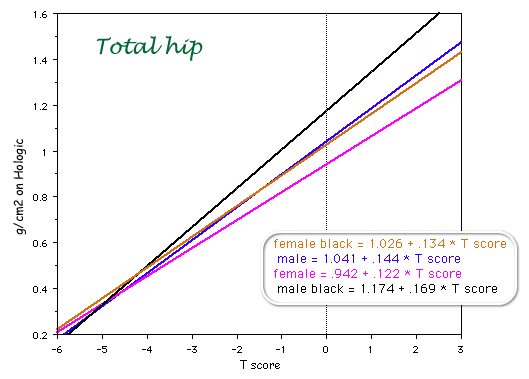
Bone Densitometry
Choose from 400 evidence-based medical calculators- including clinical equations scores and dosage formulas for optimal patient treatment at the point of care.

T score osteoporosis. As BMD decreases from this peak density fracture. T-score of -25 and below are consistent with osteoporosis. Scores of 10 are good.
A T-score of -25 or below is a diagnosis of osteoporosis. 25 or more below that of the mean level for a young adult reference population. Your best bet for detecting it in the early stages is going to the doctor especially if you.
A T score of. If your T-score is 25 or less. Your T-score shows how dense your bone are.
The World Health Organization WHO established diagnostic criteria for osteoporosis using bone mineral density BMD measurements3 BMD is reported in. If your DEXA scan indicates you have osteopeniaa T-score between -10 and -25your clinician may use the FRAX calculator. The young normal or T-score indicates how your BMD compares to that of a healthy 30 year-old.
Scores between -1 and -25 indicate Osteopenia thin bones. A T-score between 1 and 25 indicates that you have low bone mass although not low enough to be diagnosed with osteoporosis. Examples are T-scores of -26 -33 and -39.
Examples are T-scores of -11 -16 and -24. A T-score between 1 and 25 units below normal -1 to -25 is low bone mass also called osteopenia. You have osteoporosis even if you havent yet broken a.
For example a BMD T-score of -55 is lower than that of -25 and an osteoporosis score of -10 is lower than that of 10. 25 or more below that of the mean level for a young adult reference population with fractures. The higher your T-score the healthier your bones are.
Treatment for osteoporosis is based on treating and preventing broken bones and taking medicine to strengthen your bones. If your T-score is between 1 and 25. Osteopenia between normal and osteoporosis is defined as bone density T score between -1 and -25.
1998 Development and validation of a simple questionnaire to facilitate identification of women likely to have low bone density. If the T-score at any site is -1 to -25 you have a low BMD and are at increased risk of osteoporosis. This is translated as a T-score.
Definition of Osteoporosis and Osteopenia low bone density Osteoporosis was defined by the World Health Organization in 1994 as a T-score that is 25 lower than the average 30 year old or 2½ standard deviations below the mean or a T-score lower than -25. The osteoporosis Z. In 2004 the WHO operationally defined osteoporosis based upon the bone mineral density BMD assessment of the patient.
Assess for secondary causes of osteoporosis see p. References 1 Lydick E Cook K Turpin J Melton M Stine R Byrnes C. T score between 10 and 25.
Severe or established osteoporosis. Peak bone density is reached by age 30 and should ideally be maintained at this level throughout your life. Your bone density is considered normal.
If your T-score is -25 or less your doctor will diagnose you with osteoporosis. Some people have low bone density. So What do your T-score numbers actually mean.
A T-score of 25 or lower indicates that you have osteoporosis. This comparison is expressed in terms of the standard deviation or SD which you may recognize from a statistics class as being the amount that represents the typical distance above or below the mean for individual measurements. If your T-score is 1 or greater.
This is known as your T-score. This score is called the T score or T-score and it expresses the bone density in terms of the number of standard deviations SD below peak young adult bone mass. A T-score more than 25 units below normal -25 means osteoporosis and an increased risk for.
A T-score of 0 means your score is the same as the healthy adult. T score at or below 25. Thus the current osteoporosis definition is a BMD that lies 25 standard deviations or more below the average value for young healthy women a T-score of.
A positive score means that you have stronger bones than an average 30-year-old woman. How is osteoporosis treated or managed. And Scores that are less than -25 indicate Osteoporosis or.
Many of the things that raise your chances for osteoporosis are things you cant change like your genes your age and your sex. T-score History of fragility fracture is diagnostic for osteoporosis. But that doesnt mean you cant prevent the disease.
The T score measures how closely your bone density compares to that of an average 30-year-old of the same sex. Above -1 SD is normal between -1 and -25 SD shows bone loss and is defined as osteopenia. Using a Bone Density Chart to Estimate Total Bone Loss.
Men and women of any age with conditions known to be secondary causes of osteoporosis No Every 210 years depending on initial T-score See p. T score at or below 25 with one or more fractures. The lower a persons T-score the lower the bone density.
But because bone density decreases with. This stage of bone loss is the precursor to osteoporosis. A T-score of -10 is lower than a T-score of 05 and a T.
Other than changes in bone density osteoporosis doesnt usually cause a lot of initial symptoms. Scores between 1 and - 1 show normal bone mineral density. Osteoporosis is defined as a bone density T score of -25 or below.
The greater the negative number the more severe the osteoporosis. By the age of 75 50 of the population has a bone density in the osteoporosis range. What your T-score means 1 to -1 - Your bone density is in the normal range for a young and healthy person.
Osteoporosis is diagnosed when the bone mineral density is less than or equal to 25 standard deviations below that of a young 3040-year-old58 healthy adult women reference population. Whatever score you receive your risk of breaking a bone increases as you grow older. A negative score means that you have thinner bones than an average 30-year-old woman.
Therefore your doctor will look at your lowest T-scores to diagnose osteoporosis. A T-score 1 unit below normal -1 is still considered within the normal range. A T-score of -10 to -25 signifies osteopenia meaning below-normal bone density without full-blown osteoporosis.
A score of -25 or lower means that you have osteoporosis. You have low bone density known as osteopenia but not osteoporosis. There is no cure for osteoporosis but the symptoms of the disease can be managed with medicines and lifestyle changes.
A T-score of 25 or lowerthe definition of osteoporosisis an indication you may need a prescription for a medication to slow or arrest bone loss. In general the lower the T-score the lower your bone density.
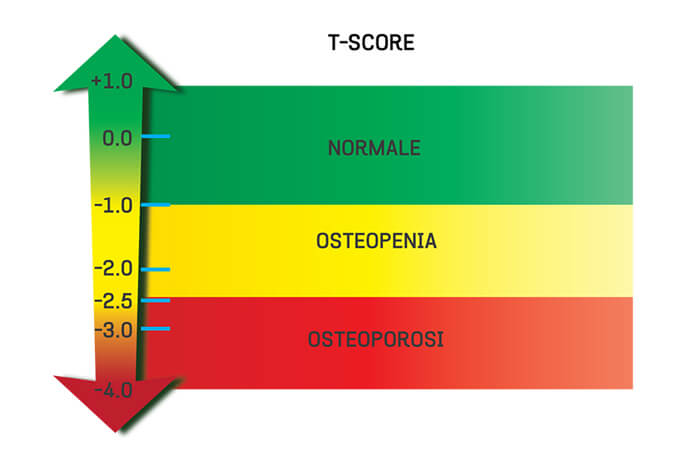
What Is T Score T Score Bone Density

Understanding The T Score Osteoporosis Tvaluetable Com

Interpretation The World Health Organization Who Osteoporosis Guidelines T Score Vs Z Score A Z Score Less Than 2 Indicates The Diagnosis Is Below Ppt Download
Strong And Stable Osteopenia Osteoporosis And Exercise

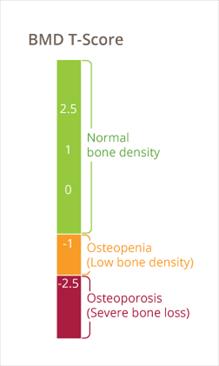
Bone Mineral Density Scan My Doctor Online
Acponline Org
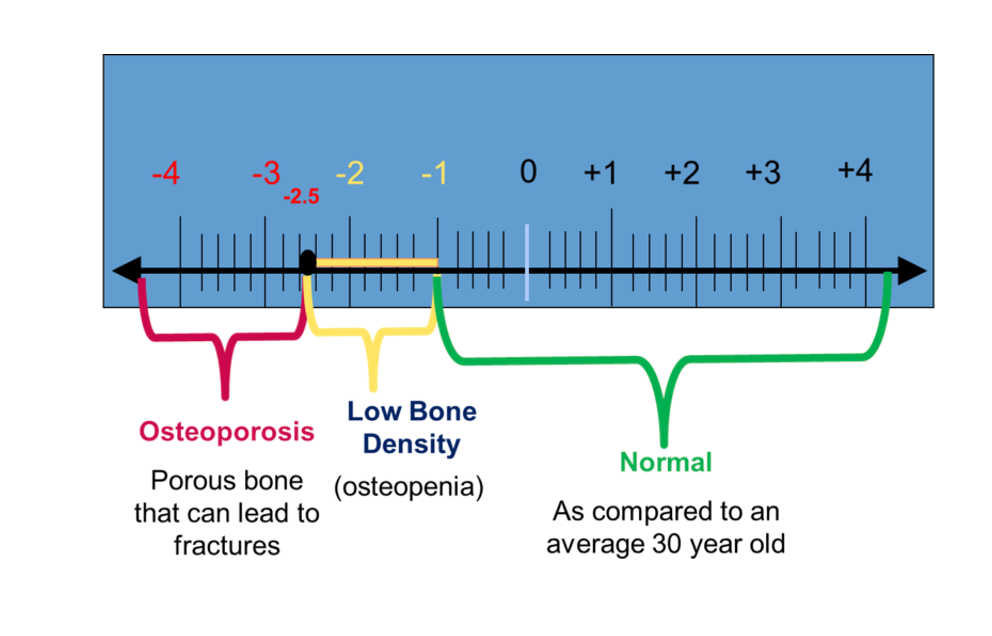
Pharmacy Clinical Pearl Of The Day Bone Density And T Score
Bone Density Testing Interval And Transition To Osteoporosis In Older Women Nejm